
Hello! Click on one of our team members below to chat on WhatsApp.
Dental aligners: definition, advantages, and limitations
TLDR
Dental aligners are custom-made clear trays created after an intraoral scan. By applying gentle sequential pressure, they correct the alignment of the arches without the need for traditional metal braces. The treatment is suitable for both adolescents and adults seeking nearly invisible orthodontics and relies on pioneering brands like Invisalign.
The benefits are numerous: discretion, comfort, and the ability to remove the trays for meals. However, there are also significant limitations: a daily wear time of 22 hours, strict discipline, high costs, and the risk of residual malocclusion—meaning persistent misalignment between the arches—if the retention phase is neglected.
After the final tray, the placement of a retainer wire, particularly in PEEK, remains essential to stabilize the result over the long term.
Table of Contents
Show
- TLDR
- 1.1 Why this technology emerged
- Typical dental aligner user case: Camille, 32, consultant
- H2: Key benefits of invisible dental aligners.
- Detailed limitations of aligners:
- Step 1 — Intraoral scan and diagnosis
- Step 2 — Digital treatment plan
- Step 3 — Manufacturing and delivery of aligners
- Step 4 — Daily wear and follow-up
- Step 5 — Finishing phase and fixed retention
- H2: What is the price of a dental aligner?
- Comparative table of aligner brands available in France (2026)
- Paying for treatment in installments
- Table of insurance providers that reimburse adult orthodontics (2026)
- Common risks & side effects
- Transient side effects: what to expect
- Effectiveness compared to braces: what the numbers say
- Why fixed retention remains essential?
- Focus on the new PEEK retention
- Conclusion
What is a dental aligner?
A dental aligner is a clear, removable, and personalized orthodontic appliance that progressively moves teeth through a series of evolving trays.
It gradually replaces traditional metal braces and offers numerous advantages such as near-total discretion and increased comfort without irritating wires or brackets.
1.1 Why this technology emerged
Faced with the demand for discreet orthodontics and the technological leap in custom plastic materials, aligners have quickly established themselves as the contemporary alternative to braces.
- Advances in medical plastic thermoforming and 3D modeling.
- Rapid adoption by orthodontists for mild to moderate cases of Class I and II malocclusions.
Finally, the growing refusal among active adults to wear visible braces in professional and social life truly triggered the democratization of invisible dental aligners, now perceived as the ideal option combining discretion and orthodontic efficiency.
1.2 Main target audiences
As mentioned above, aligners do not appeal to everyone for the same reasons: each audience has its own motivations and constraints. Here is a quick look at what makes the difference for each:
- For adolescents, discretion is paramount: they are more comfortable with a nearly invisible appliance, can easily remove it for meals, and maintain simplified hygiene without braces or wires.
1.3 How aligners work
Each aligner is designed from a 3D scan: it incorporates a maximum of 0.25 mm of movement per tooth and is worn for 7 to 14 days. The plastic exerts a gentle, continuous force that triggers bone remodeling: the bone resorbs on one side of the tooth and rebuilds on the other, hence the need for 22 h/day wear to maintain pressure.
Resin attachments can be added to guide more complex movements and ensure that each tooth follows the exact intended path.
Typical dental aligner user case: Camille, 32, consultant
Camille had never worn braces.
At 32, she was unhappy with the slight crowding of her lower incisors. Not to the point of “redoing everything,” but enough to avoid close-up photos.
During the first consultation, the intraoral scan reveals 3 mm of crowding, perfectly compatible with aligner treatment. The digital plan anticipates 18 trays + a finishing reassessment, totaling approximately 8 months of correction.
The first few days, slight pressure. Nothing disabling, and no notable side effects are reported.
The real challenge? Wearing the trays 22 hours a day despite client lunches.
By the final tray, alignment is achieved.
But her orthodontist insists: without fixed retention, the result can degrade within a few months.
Camille opts for an eZtain nearly invisible lingual bonded wire; three years later, her alignment has not moved.
Advantages & limitations of invisible aligners
H2: Key benefits of invisible dental aligners.
| Aspect | Detail |
| Discretion | Clear plastic, nearly invisible at 1 m. |
| Comfort & hygiene | Absence of wires/metal plates; removable for brushing. |
| Digital precision | Virtual simulation of the final result; monitoring via intraoral scanner at each check-up. |
| Fewer appointments | Visits spaced 6 to 8 weeks apart thanks to digital planning. |
What are the main disadvantages of a dental aligner?
The main disadvantages are strict discipline (22 h/day), transient pain during changes, and a risk of cavities if hygiene is poor during treatment.
Detailed limitations of aligners:
Before enjoying the benefits of aligner treatment, it is essential to understand its limits: these clear trays only move teeth if they are worn almost continuously, closely monitored by a specialist, and supplemented by fixed retention. The following points explain, one by one, the factors that can slow down treatment, increase costs, or compromise the stability of the result if the protocol is not strictly followed.
- Daily wear: prolonged removal of more than 2 hours slows down or even cancels movement.
- Cost: sequential manufacturing, digital monitoring, and expert fees can be more expensive than fitting metal braces.
- Initial adaptation: sensation of slightly altered speech as well as pressure on the teeth.
- Possible failures: Failures can occur if the protocol is not followed; complex malocclusions then often require additional attachments or the use of orthodontic mini-screws to regain control of movements.
- Relapse without retention: Without retention, relapse is almost inevitable; only the placement of a bonded wire, possibly reinforced by a nighttime tray, ensures the long-term stability of the teeth.
Key takeaway: aligners correct, retention maintains; discuss the post-treatment fixed solution during the first consultation to secure the result.
What problems can aligners correct?
Aligners are very effective for realigning teeth when the misalignment remains moderate. For very complex cases, small fixed sectional braces may sometimes be needed. Specifically, they address:
- Overlapping teeth
When the arch is too narrow and teeth overlap each other, the trays create micro-spaces and move each tooth back into its place. - Gaps between teeth (diastemas)
If you see a “hole” between two teeth, the aligner gently brings the crowns together until the gap is closed. - Slight front-to-back jaw misalignment (moderate Class II or III)
With the help of elastics, the trays can move an arch forward or backward by a few millimeters, which is sufficient in many adult cases. - Deep bite (overbite) or slight open bite
They can slightly intrude (push in) or extrude (pull out) certain teeth so that the upper and lower incisors meet correctly. - Slight dental crossbite
When an upper tooth “bites” behind a lower one, the aligner moves the offending tooth laterally to restore proper occlusion. - Relapse after previous treatment
If your teeth have moved again years after braces, a short series of aligners restores alignment without returning to a fixed appliance.
Thus, as long as the misalignment is not related to a major bone problem, aligners offer precise, discreet, and more comfortable correction than traditional braces. It is necessary to be cautious of “cheap” aligner offers, as these are only effective at the margins and rarely allow for the implementation of effective treatment.
3. The step-by-step patient journey
Step 1 — Intraoral scan and diagnosis
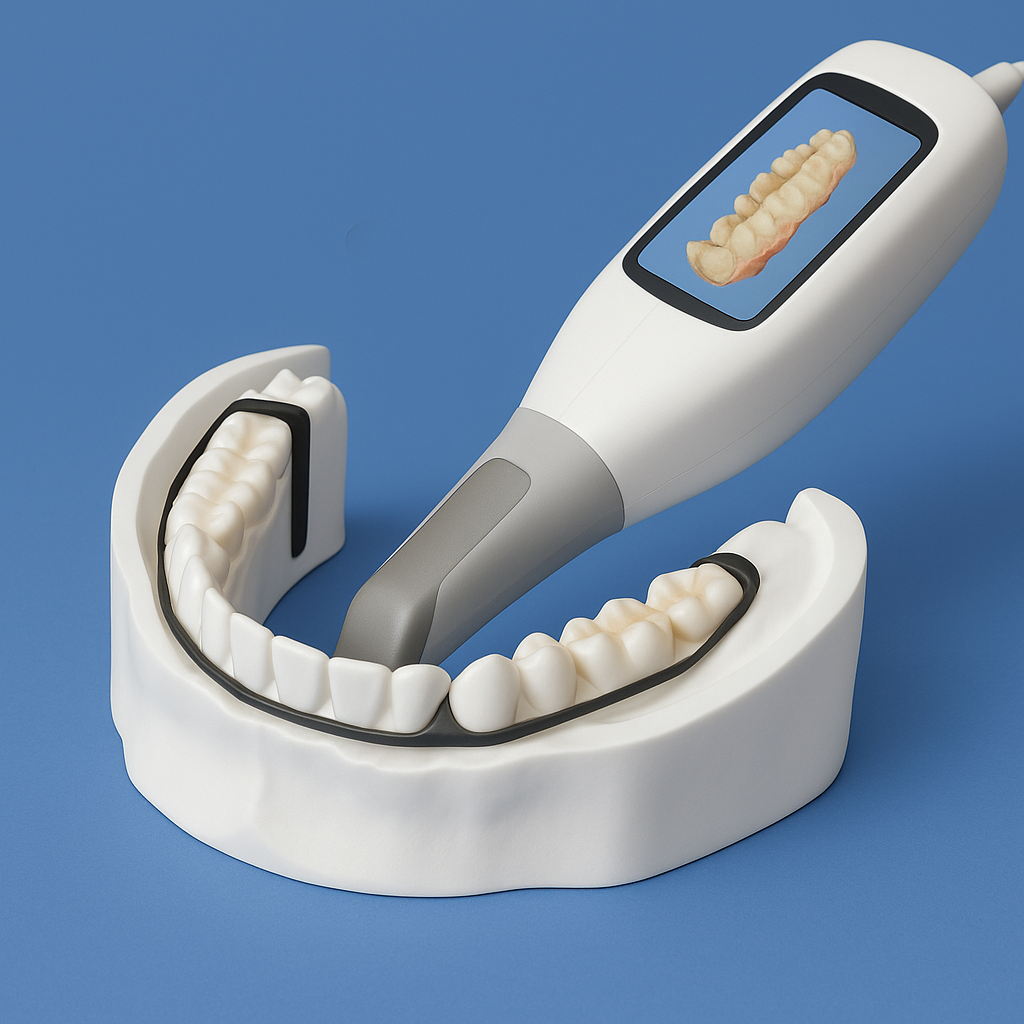
The first appointment begins with a high-resolution intraoral scan. The orthodontist analyzes the occlusion and virtually models the necessary movements; a 3D rendering already allows for visualization of the final result.
Step 2 — Digital treatment plan
The software breaks down the correction into micro-movements (≤ 0.25 mm). Each tray represents a “key” in the sequence: on average, 10 to 40 aligners are used depending on the severity of the malocclusion.
Step 3 — Manufacturing and delivery of aligners
The trays are thermoformed from clear medical plastic. Attachments (small resin dots) can be bonded to certain teeth to increase the precision of the controlled movement.
Step 4 — Daily wear and follow-up
Recommended wear: 22 h/day. Removal only for meals and oral hygiene. A clinical check-up or video follow-up is scheduled every 6 to 8 weeks; a new intraoral scan adjusts the trajectory if necessary.
Step 5 — Finishing phase and fixed retention
By the final tray, alignment is achieved but unstable. The orthodontist immediately places a lingual bonded wire and may also prescribe a nighttime tray: the combination ensures the permanence of the smile. eZtain’s nearly invisible PEEK solution then offers a durable alternative to metal wires.
4. Price, reimbursement & insurance
H2: What is the price of a dental aligner?
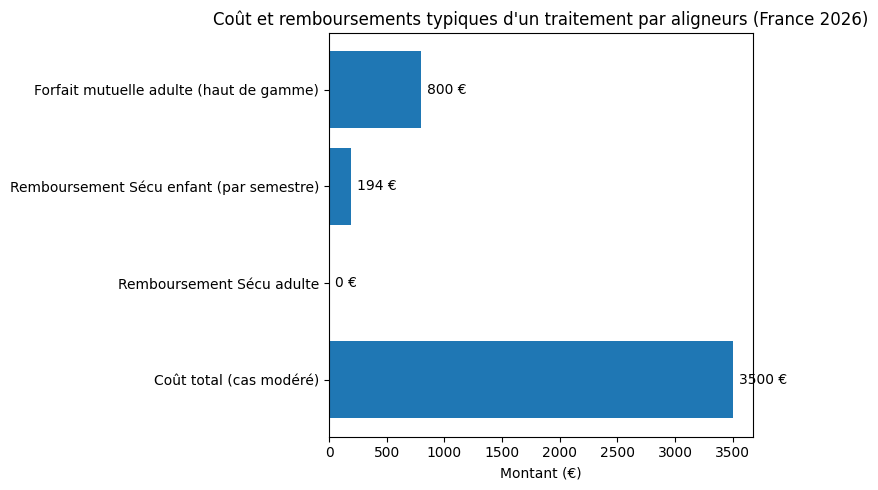
from €1,800 to €6,500 in France for complete treatment, depending on the complexity of the malocclusion, the number of trays, and the brand’s reputation (e.g., Invisalign).
The price of a dental aligner can depend on several factors. Adolescent patients (under 16) treated in an orthodontic practice may benefit from social security coverage rates (TO 90 = €193.50/semester), but almost the entire cost for adults remains the patient’s responsibility.
Price breakdown
| Item | Range | Comment |
| Assessment & scans | €150 – €300 | Includes panoramic / ceph x-rays |
| Aligner manufacturing | €700 – €1,800 | Depends on the number of trays |
| Orthodontist fees | €900 – €3,000 | Follow-up, check-ups, adjustments |
| Final retention | 150 – 400 € | Bonded wire + night tray |
Comparative table of aligner brands available in France (2026)
| Category | Brand | Material / Patent | Clinical supervision | Price range* |
| In-practice | Invisalign | SmartTrack PU | 100% in-practice (certified orthodontist) | €1,500 – €6,500 |
| In-practice | Spark | TruGEN PET-G | 100% in-practice | €2,000 – €5,000 |
| In-practice | Smilers | Triple-layer PU 🇫🇷 | 100% in-practice | €2,000 – €4,500 |
| In-practice | SureSmile | Essix ACE | 100% in-practice | €2,500 – €4,500 |
| Hybrid | DrSmile × Impress | SmartFlex PET-G | In-practice + mobile app | €1,590 – €2,890 |
| Hybrid | Joovence | Multi-layer PU | In-practice + remote monitoring | €1,600 – €3,500 |
| Hybrid | Aligneurs Français | Recycled PU | In-practice + app | €1,500 – €3,500 |
| Online | SmileDirectClub | Standard PU | Home impression kit, without clinical follow-up | €1,750 – €2,250 |
*Average rates in France 2026, excluding retention.
In the French market, Invisalign and Dr Smile act as leaders, but new brands regularly offer innovations.
The SmileDirectClub precedent in the dental aligner market
At the end of 2023, the global bankruptcy of SmileDirectClub left tens of thousands of patients without follow-up or recourse. No radiological assessment was required; trays were shipped without clinical examination or signed informed consent, and no medical liability was engaged in case of complications (cavities, gum recession, unforeseen migration).
The SmileDirectClub episode serves as a reminder that before choosing a brand, three guarantees are non-negotiable:
- A complete diagnostic imaging assessment (panoramic, cephalometric, CBCT) established by a qualified practitioner; without these exams, the tray can move weakened or poorly positioned teeth.
- Regular clinical follow-up to check the “tracking” of the aligners, adjust attachments, and immediately treat any side effects.
- Legal traceability and professional insurance that bind the practice in case of complications.
Absent in low-cost online offers, these three conditions must become your decision criteria before signing any quote.
Are dental aligners reimbursed?
No for adults; yes, partially (€193.50/semester) for those under 16 with prior agreement. Beyond that, Assurance Maladie considers the treatment as aesthetic.
In practice, the reimbursement framework can be summarized in three points:
- 100% Health Scheme: only before age 16
Until age 16, one semester of orthodontics (€193.50) is 100% covered upon prior agreement; the insurance provider pays the co-payment. Beyond that, this aid disappears.
In other words, after age 16, financing rests almost entirely on the patient.
Which insurance provider covers dental trays?
“Adult Orthodontics” contracts from certain providers (e.g., MGEN, Harmonie Mutuelle, Malakoff Humanis) reimburse 150% to 300% BR or an annual flat rate of €300 – €800. You should check:
- Cap per year and per beneficiary.
- Number of semesters reimbursed.
- Requirement for a prior quote with a digital treatment plan.
Financing and insurance: figures to know
Paying for treatment in installments
| Solution | Terms | Indicative amount / duration | Considerations |
| In-practice installment plan | 3–24 monthly installments without fees | e.g., €120 × 18 months for a €2,160 plan | Check penalties for late payment |
| Health credit (dedicated organizations: Cetelem Santé, Cofidis, Finfrog) | Fixed APR 6% – 15% over 12-48 months | e.g., €33 × 48 months (15.9% APR) for €1,590 | Read the total cost; early repayment penalties |
| Supplemental dental insurance | Premium €15-30/month | Additional reimbursement €400-700/year | Waiting period 6-12 months |
| Personal Training Account (CPF) | Not eligible | – | Contrary advertisements = scams |
To limit borrowing costs, prioritize in-practice installment plans first; health credit should only be considered beyond 24 months.
Table of insurance providers that reimburse adult orthodontics (2026)
| Insurance Provider | Annual adult orthodontics flat rate | Waiting period | Semiannual cap |
| Kovers de Toucy | €1,500 | 12 months | €750 |
| Swiss Life | €750 | 6 months | €375 |
| AG2R La Mondiale | €1,000 | 6-12 months | €500 |
| Harmonie Mutuelle | 250% BRSS + €300 | 6 months | €193.50 + €150 |
| Malakoff Humanis | Dedicated guarantee (€900/year) | 12 months | €450 |
How to optimize your orthodontic quote
- Check the “orthodontics not reimbursed by SS” line in the guarantee table.
- Ensure that the waiting period will have elapsed before the attachments are placed.
- Request a written coverage certificate before signing the treatment plan.
Risks, precautions & scientific evidence
Common risks & side effects
Aligners remain safe, but several complications are documented:
| Risk | Prevalence* | How to prevent |
| Cavity / demineralization | < 10% | Brushing after every meal; fluoride mouthwashes. |
| Gingivitis | 6 % | Daily interdental cleaning, check-ups every 2 months. |
| Gum recession | < 3% | Limit excessive tipping movements. |
| Movement failure | 8 – 12% | Adherence to 22 h/day, use of attachments or mini-screws. |
| Relapse | > 25% without retention | Fixed wire + night tray. |
*Average data from 2020-2024 meta-analyses. Studies show an overall success rate of 80 – 88% for mild to moderate malocclusions when wear discipline is followed.
Transient side effects: what to expect
Aligners rely on light but continuous forces; the body therefore reacts, especially in the first few days:
- Mild pain (24 – 48 h) – This sensation of pressure proves that the alveolar bone is remodeling; it disappears with a simple analgesic and a switch to soft foods. Systematic reviews published in the Journal of Orthodontics confirm that fewer than 15% of patients exceed level 3 on the VAS scale.
- Speech alteration (2 – 3 days) – The tongue must “learn” to coexist with the tray. Reading aloud exercises speed up adaptation, bringing the discomfort score to 0 by the fourth day according to the Angle Orthodontist.
- Hypersalivation – Observed mainly in the first few days, then regulates naturally.
These manifestations are temporary, predictable, and manageable: they signal that the treatment is working without exceeding the tolerated biomechanical threshold.
Effectiveness compared to braces: what the numbers say
Comparative studies show that aligners are not only more discreet; they also hold their own against metal braces on several key indicators:
| Indicator | Aligners | Metal braces | Simplified reading |
| Average treatment duration | 11.2 months | 17.6 months | Gain ≈ 6 months in comparable cases |
| Incisor rotation | 72% precision | 82 % | Aligners are effective but often require attachments and reassessments to achieve the same result |
| Patient satisfaction (OHIP-14) | 4,6 / 5 | 3,2 / 5 | Comfort and aesthetics clearly in favor of trays |
Key takeaway: aligners reduce treatment time and improve perceived comfort. The only notable exception: for certain complex rotations or root torques, they require additional devices (attachments, mini-screws) where braces achieve the result more simply. In practice, a good initial diagnosis allows for anticipation of these adjustments and avoids any disappointment.
Post-aligner retention: key to stability
It is often 6 to 12 months after the end of treatment that patients who neglected their retention return for a consultation due to the onset of relapse.
Why fixed retention remains essential?
Periodontal fibers remember the initial position for up to 12 months after the end of treatment. Without retention, the force of the soft tissues gradually brings the teeth back: relapse risk > 60% after five years.
The role of the bonded wire
- 24/7 maintenance without dependence on patient discipline.
- Lingual position, completely invisible.
- Recommended duration: minimum 5 years, ideally for life.
Nighttime tray: useful but secondary
- Limits vertical micro-movements.
- Does not replace the wire: effective only during wear (8 h).
- Good compromise if worn rigorously.
Focus on the new PEEK retention
| Criterion | Traditional steel wire | PEEK eZtain wire |
| Visibility | Metallic, can reflect light | Ivory / enamel color, invisible |
| Rigidity | Very high → risk of debonding | Controlled flexibility, increased comfort |
| Biocompatibility | Nickel: possible allergy | 100% hypoallergenic PEEK |
| Durability | 3 – 5 years before replacement | > 7 years tested for mechanical fatigue |
Conclusion
Today, dental aligners offer an aesthetic and effective response to mild to moderate malocclusions, provided that a complete radiological diagnosis is made and rigorous clinical follow-up accompanies every step.
Their success rests on three pillars: a precise digital treatment plan, the discipline of wearing them 20–22 h per day, and above all, the immediate placement of fixed retention to preserve the result.
Long-term scientific data is clear: without a bonded device, more than six out of ten patients see their smile degrade within ten years. Choosing an innovative PEEK retention, MRI-compatible and nearly invisible, therefore means securing the financial investment and the comfort gained during treatment for the long term.
The durability of aligner treatment rests on three requirements: a precise radiological diagnosis, a 22 h/day wear discipline, and above all, fixed retention placed as soon as the final tray is finished. Without this trio, more than six out of ten patients will see their alignment degrade within ten years.