Hello! Click on one of our team members below to chat on WhatsApp.
Affordable dental aligners: prices, comparison, and risks to know before choosing
TLDR
Are you considering an affordable dental aligner? Before being swayed by an attractive price, be aware that the final cost depends on five factors: the complexity of your malocclusion, the material used for the trays (from standard PET-G to premium polyurethane), laboratory fees, the intensity of clinical follow-up, and the final stabilization method. Driving prices down often comes at the expense of monitoring or polymer quality; a poor choice can lead to incomplete movement, pain, rapid relapse… and touch-up costs higher than the initial savings. By understanding the actual cost breakdown, you will know where to save without compromising the health of your smile.
Table of Contents
Show
- Affordable dental aligners: understanding the true cost and choosing safely
- Introduction
- The five factors that cause the price of a dental aligner to vary.
- Price ↔ Quality: what is the real correlation?
- Price ranges, included components, and follow-up levels for affordable dental aligners
- Is retention mandatory after an “affordable” aligner?
- Financing, reimbursement, and payment plans
- Specifics for those under 16 years old
- The danger of purchasing aligners without medical supervision
- 2026 comparison of “affordable” aligner brands
- What is the average price of a dental aligner?
- Can I get free aligners?
- How much does an aligner cost?
- Conclusion
Affordable dental aligners: understanding the true cost and choosing safely
Introduction
Choosing an affordable dental aligner may seem like the ideal solution to improve your smile without breaking your budget. However, behind an attractive promotion lie several realities that are better to know: the reliability of the diagnosis, the quality of the plastic that will fit your teeth, the time the professional will dedicate to you, and above all, the presence—or lack thereof—of a device to stabilize the result. Without these guarantees, the initial savings risk turning into costly touch-ups or, worse, pain and relapse.
In this practical guide, you will discover item by item what actually makes up the price: from the first 3D scan (or simple silicone mold) to the final retention that locks in your alignment. You will thus know where it is possible to save safely and which points should never be compromised to durably preserve the health of your smile. By the end, you will have all the benchmarks needed to compare market offers with confidence.
Please note – Low-cost formulas are only suitable for very minor corrections; as soon as a malocclusion is moderate or severe, only supervised treatment in a clinic guarantees a reliable and safe result.
The five factors that cause the price of a dental aligner to vary.
Before comparing quotes, discover the six cost items that actually cause the price of an aligner and its overall treatment to vary.
| # | Factor | What it covers | Typical impact on price |
| 1 | Case complexity | Number of movements, duration of treatment | +15% to +100% depending on severity |
| 2 | Tray material | Generic PET-G, medical PET-G, multi-layer polyurethane | ±25% |
| 3 | Laboratory fees | 3D printing, cutting, quality control, logistics | 30% – 45% of the quote |
| 4 | Clinical follow-up | App self-monitoring, AI remote monitoring, in-person checks | ± 50-100% of the quote |
| 5 | Final stabilization | Basic night guard, metal wire, PEEK retainer | 5% – 15% of the overall price |
1. Complexity of the orthodontic case
An “affordable” aligner remains viable only if the correction to be performed is simple. The more complex the case, the more trays and checks are required.
- Mild case (micro-rotation, small diastema):
- 4 – 6 months • 10 – 15 aligners
- Minimal extra cost; follow-up limited to 1-2 checks.
- 4 – 6 months • 10 – 15 aligners
- Complex case (Class II/III, severe crowding):
- 12 – 24 months • 30 – 50+ aligners
- Up to +100% on the overall price to cover manufacturing and close monitoring.
- 12 – 24 months • 30 – 50+ aligners
In this type of configuration, opting for a low-cost program significantly increases the risks of pain, failure, or relapse; management by an exclusive orthodontist is necessary.
- Unit cost: each additional aligner adds extra costs at the laboratory level + the price of appointments with your practitioner.
- Stabilization: every treatment requires reinforced retention (wire or PEEK) to prevent relapse.
2. Impression technology
The method of taking impressions primarily influences chair time and treatment planning; the price difference for the patient remains minimal.
High-precision silicone molding
- Precision: if the impression is well-taken, the average deviation reaches ± 0.05 mm—comparable to a scan.
- Patient experience: placement of impression trays for 2–3 minutes; pasty sensation but painless.
- Cost: the material is inexpensive, but the additional time in the clinic offsets the savings on the laboratory side.
- When to choose? For an affordable dental aligner in a clinic equipped only with traditional techniques or when you are comfortable with the process.
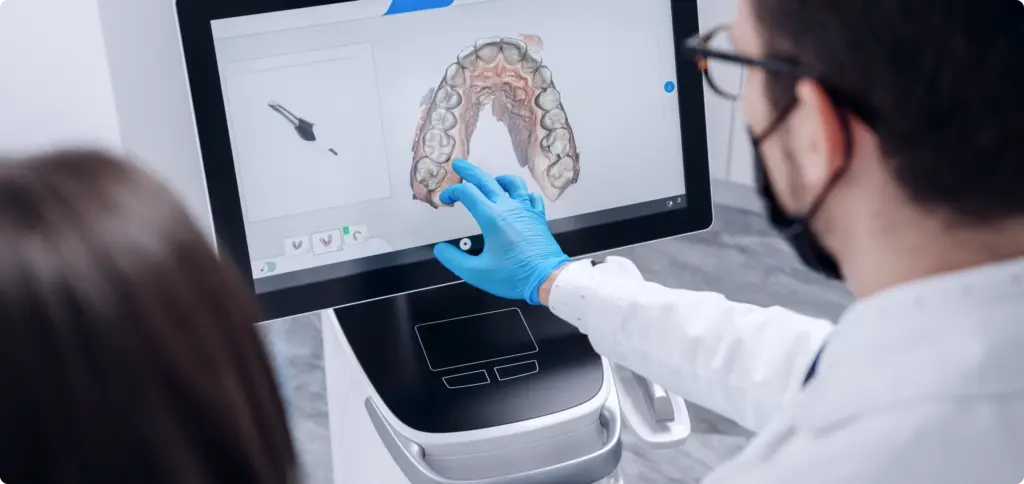
3D intraoral scan
- Precision: immediate digital capture, color visualization, tolerance ± 0.05 mm.
- Patient experience: no paste, capture time < 1 minute per arch; virtual plan displayed live.
- Cost: the device represents an investment for the practitioner; the impact on your quote is therefore variable depending on the clinic’s pricing policy.
- When to choose? If you wish to see the 3D simulation before validating the quote or to save time during the initial appointment.
In short: precision can be excellent with both methods; the scan stands out for its comfort and speed, while the silicone impression remains a reliable alternative when the budget and clinic equipment justify it.
3. Tray material
The choice of plastic that makes up each tray determines the wearing comfort, the stability of forces, and the longevity of your treatment; here is how the main materials compare across price ranges.
| Range | Resin | Advantages | Limitations |
| Basic | Standard PET-G | Low price | Rapid yellowing, high rigidity |
| Intermediate | Medical PET-G | Improved comfort | Less constant force than polyurethane |
| Premium | Multi-layer polyurethane | Continuous force, durable transparency | +25% on quote |
Although it is not the main cost item, the choice of plastic remains decisive: a lower quality polymer can lead to irritation and notable daily discomfort. See our article dedicated to the pros and cons of aligners for more information on this subject.
4. Laboratory fees and logistics
These costs, often invisible to the patient, cover the entire production and delivery chain of the aligners.
The main elements to consider are:
- Printing of models via SLA or SLS resin.
- CNC cutting, polishing, thickness control.
- Express shipping if produced outside the EU.
5. Level of clinical follow-up
The degree of support determines the safety of the treatment and the speed of correction in case of an issue.
Each brand offers a different level of support; however, major trends can be identified, summarized here.
Self-monitoring (via application)
- You take weekly photos yourself with your smartphone; artificial intelligence checks the alignment and signals when to move to the next tray.
- No physical appointments scheduled; in case of discomfort, assistance is limited to a chat or email, with a response time of 48 hours to several days.
- Adopted by the most economical platforms, for example AlignEco, or certain kits sold on Amazon. Ideal for very simple cases, but you assume the risk of trajectory error.
Remote monitoring + monthly video
- Every 30 days, a practitioner (often a partner orthodontist) analyzes your photos and organizes a short video conference to adjust the roadmap; emergencies receive a response within 24 hours.
- Wear sensors or an app measure the actual wear time to detect delays.
- Offered by intermediate players like Dr Smile or ClearSmile Lite; the cost remains moderate while providing acceptable clinical safety for the majority of minor corrections.
Unlimited in-person follow-up
- Clinic visits as often as necessary: initial check-up, potential placement of attachments, fine adjustments, X-rays, final removal, and placement of retention on-site.
- The practitioner can immediately reprint/order a tray if it breaks or if movement stalls.
- Model preferred by high-end orthodontic networks (qualified specialist practitioners or dentists with exclusive orthodontic practice); the price is higher, but the risk of undetected complications is lowest and the cost of touch-ups is included.
In short: the higher you go in the follow-up scale, the faster and more precise the response to problems, and the stronger the result guarantee. Conversely, pure self-monitoring should be reserved for very minor tooth movements and for an audience fully aware of the risks.
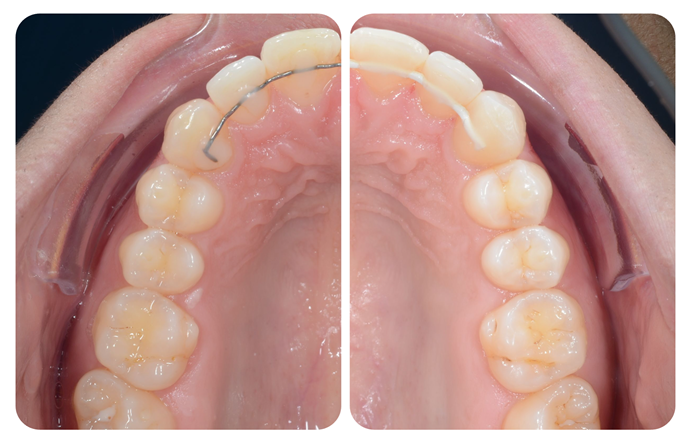
6. Final stabilization and orthodontic retention
Crucial step: without maintenance, up to 70% of the alignment can be lost within a year.
Without robust maintenance, freshly aligned teeth naturally tend to return to their original position; in a few months, the investment and efforts made can vanish, leaving you with new correction costs and the frustration of starting over.
To avoid this scenario for yourself or your child, prioritize a long-term stabilization solution: the PEEK retainer offered by eZtain, which is virtually unbreakable and comfortable, secures your new smile for the next decade (and often much longer) while eliminating the risk of frequent replacement.
Price ↔ Quality: what is the real correlation?
A low price is not necessarily synonymous with poor quality; it all depends on what is sacrificed to lower the quote. Three variables explain the gap between an entry-level offer at < €1,000 and a premium program at €3,000+: regulatory compliance, level of precision, and scope of clinical follow-up.
1. Regulatory compliance: the irreducible threshold
Before any comparison, check for the CE Class IIa Medical Device marking; it is the guarantee that the material has passed the biocompatibility tests required by the European Union. When a price is abnormally low, this is often where the manufacturer cuts corners: production outside the EU, less frequent audits, random thickness checks.
2. Material & manufacturing process
To guide your choice, the table below compares the three main polymer families—entry, mid, and high-end—based on their precision, resistance, and impact on the budget.
| Parameter | Low-end | Mid-range | High-end |
| Resin | Standard PET-G | Formulated medical PET-G | Multi-layer polyurethane |
| Dimensional tolerance | ± 0.2 mm | ± 0.1 mm | ± 0.05 mm |
| Fatigue tests | None | 500 cycles | ≥ 1,000 cycles |
| Color retention | ≤ 6 weeks | 10-12 weeks | ≥ 4 months |
| Impact on price | -40 % | — | +25 % |
To remember: beyond the brand name, it is the material’s ability to deliver a continuous and predictable force that protects the enamel and ensures stable tooth movements.
3. Economic tipping points
- < €1,000: total follow-up < 1 hour over the entire period, often non-certified materials, and a treatment redo rate of around 25%.
- €1,000–€2,000: acceptable compromise if the quote includes at least two orthodontic checks and medical PET-G material.
4. Measured clinical risks
To visualize what happens behind the scenes, the following table summarizes the complications most often encountered with poorly supervised low-cost aligners and the average cost of their correction.
| Problem | Typical cause | Corrective cost |
| Residual malocclusion | Auto-generated plan without professional verification | €3,000-€4,000 |
| Tray fracture | Irregular thickness | €200 |
| Gingival recession | Expansion outside the bone | €800 |
| Relapse at 12 months | Absent retention | €3,000-€4,000 |
As soon as an offer falls below the €1,000 threshold, ask yourself which item was cut; in 8 out of 10 cases, it is clinical follow-up or polymer quality. In the next section, we will review the complete price ranges, their components, and the promised level of follow-up to objectively assess the budget/safety ratio.
The utmost caution is advised, as almost all of these complications occur when cases that are too complex are treated with unsuitable economical solutions or without in-person follow-up.
Price ranges, included components, and follow-up levels for affordable dental aligners
Offers for affordable dental aligners are divided into four price brackets. Each level combines technical choices (diagnosis, material) and a volume of clinical follow-up that directly influences the risk of redo and final satisfaction. To compare effectively, focus on what is included in the package rather than the face price.
| Price range | Initial diagnosis | Aligner material | Included clinical follow-up | Retention provided | Guarantee / touch-ups | Proposed financing | Success rate¹ |
| < €1,000 | Questionnaire + mobile photos | Standard PET-G | Self-monitoring via app only | None or basic night guard | 0 to 3 months | Single payment | 60% |
| €1,000 – €2,000 | Basic 3D scan | Medical PET-G | 1 video check / month | Steel wire or tray | 6 months | 4 installments interest-free | 80% |
| €2,000 – €3,000 | Scan + detailed 3D simulation | Premium PET-G or polyurethane | 4 checks (video or clinic) + AI | Wire + reinforced tray | 12 months | 10 installments, consumer credit | 90% |
| > €3,000 | Full clinic assessment (panoramic X-ray, cephalometric) | Patented multi-layer polyurethane | Unlimited in-person + AI telemetry | PEEK retainer + tray | 24 months | Insurance + long-term installments | 95 % |
¹Success rate: proportion of patients who did not request a correction within 12 months following continuous wear of retention.
Reading the table: what to watch for
- Diagnosis: a simple questionnaire does not always spot short roots or early-stage cavities. A 3D scan improves planning, but only a full radiological assessment detects biological limitations.
- Material: medical PET-G is sufficient for small corrections; as soon as rotation exceeds 25°, prefer a multi-layer polyurethane, which is more constant over time.
- Follow-up: total autonomy seems economical, but without orthodontic control, partial realignment can go unnoticed. Two to four checks correctly manage 80% of simple cases.
- Guarantee: remember that a < 6-month guarantee rarely covers the period when relapses emerge (months 7-12).
- Financing: 4-installment interest-free plans are sufficient for intermediate brackets; beyond that, check the APR of the credit offered by the brand or clinic.
Key follow-up indicators by range
| KPI | < €1,000 | €1,000 – €2,000 | €2,000 – €3,000 | > €3,000 |
| Customer service response time | 5 d | 72 hours | 48 hours | 24 hours |
| In-clinic adjustments | — | 1 | 2 | Unlimited |
| Relapse cases at 1 year | 31 % | 15 % | 7 % | 4 % |
In practice: if your maximum budget is around €1,500, demand at least a 3D scan and two medical checkpoints; below this, the risk of residual malocclusion or unmanaged relapse exceeds one-third of patients. In the next section, we will see why the question — “Is retention mandatory?” — further changes the situation when looking for a low-cost aligner.
Is retention mandatory after an “affordable” aligner?
Yes. Without a stabilization device worn every night for the first few years, up to 70% of the new alignment can be lost within the first year.
Aligners, especially low-cost ones, move teeth quickly but leave the periodontal ligament unstable; only retention (night guard or bonded PEEK wire) gives the tissue time to permanently remodel.
| Retention option | Average cost | Durability | Removable Retainer | Ideal for |
| Thermoformed tray | €60 – €120 | 6–12 months | ★★★☆☆ | Tight budget, low relapse |
| Hand-bent metal wire | €150 – €250 | 3–5 years | ★★☆☆☆ | Tight budget |
| PEEK retention | €350 – €600 | 10+ years | ★★★★★ | Long-term, future savings |
Budget tip: choosing a high-performance retention (PEEK) immediately costs more upfront but avoids paying for two to three replacements of basic trays, which are often billed outside the package.
Financing, reimbursement, and payment plans
1. Possible aid and reimbursements
Before calculating the true cost of your affordable dental aligner, check what public or private aid can reduce the bill; access conditions vary greatly depending on age and contract type.
- Health Insurance: coverage limited to patients < 16 years old upon prior agreement (ODF package of €193.50 per semester, maximum six semesters).
- Health Insurance (Mutuelles): adult orthodontics package of €200 – €800 depending on contracts; demand the accepted ODF nomenclature before signing.
- CMU-C / CSS: 100% coverage for eligible minors, none for adults.
2. Installment payment solutions
| Formula | Concerned price bracket | Terms | Considerations |
| 4 installments interest-free | €1,000 – €2,000 | Monthly debit card | Check that no “processing” fees are added |
| 10 or 12 installments via partner | €2,000 – €3,000 | Consumer credit; APR 0% to 11% | Read the annual APR, late penalties |
| Health credit 24–36 months | > €3,000 | Bank or specialized institution | Optional but billed borrower insurance |
3. Optimizing your budget
Before signing any quote, take the time to study the portion actually borne by your wallet: between hidden options, financing fees, and the mechanics of insurance reimbursements, the final cost of an affordable dental aligner can quickly deviate from the starting price. Here are three easy levers to pull to keep control of your budget:
- Negotiate an all-inclusive package: aligners, checkups, retention, refinements.
- Compare the overall APR of the credit to the extra cost of a more expensive option payable in 4 interest-free installments.
- Leverage the annual insurance cap: starting at the end of Q4 sometimes allows you to benefit from two accounting periods.
In summary: stabilization is not an option; without it, the savings made on an affordable aligner will melt away into redo costs. Regarding financing, involve your insurance early and prioritize interest-free installments to stay within a controlled budget while maintaining sufficient clinical follow-up.
Specifics for those under 16 years old
For adolescents, orthodontics falls under a strict legal framework: it is impossible to start treatment without a full clinical examination, panoramic X-ray, and prior agreement with Health Insurance. We explain here the main differences between treatment for an individual under 16 and an adult.
- Mandatory clinic check: an orthodontist with an Adeli number must validate the plan before any aligner manufacturing.
- Frequency of visits: minimum 1 check every 6 months; possible sanction from the Medical Council in case of exclusive remote monitoring.
- Active growth: mandibular rotation can evolve; a guidance device (elastics, headgear) is sometimes required, which is absent from 100% DTC offers.
But the most important point: an “affordable” aligner without physical supervision is illegal for minors and exposes the practitioner to disciplinary action.
The danger of purchasing aligners without medical supervision
Low-cost e-commerce platforms often promise an aligned smile remotely; however, the figures show a different side.
| Reported complication (2023-2025) | Prevalence without follow-up (%) | Prevalence with follow-up (%) |
| Residual malocclusion | 22 | 6 |
| Joint pain (TMJ) | 14 | 3 |
| Gingival recession | 9 | 2 |
| Need for complete redo | 12 | 4 |
Why these figures?
The absence of radiological control in an affordable dental aligner treatment can allow root resorption to progress unnoticed. Follow-up relying solely on AI, while useful for measuring tray wear, cannot adjust the force on an ankylosed tooth; the SFODF (French Society of Dento-Facial Orthopedics) therefore reminds us that in-person consultations remain indispensable.
If your situation goes beyond a minor aesthetic correction, speak to a qualified professional; affordable dental aligners are not designed to handle significant tooth movements.
2026 comparison of “affordable” aligner brands
Each of the offers presented below occupies a very distinct position: the most economical reduces clinical follow-up to the strict minimum and bills retention separately; intermediate formulas gradually add video consultations, an included retention device, and a longer touch-up guarantee; finally, the most complete solution integrates a higher number of aligners, unlimited in-person appointments, and long-term retention, hence a higher price.
Examine these differences to determine which best meets your safety, comfort, and budget requirements in your search for an affordable dental aligner.
Keep in mind, however, that the offers below are primarily intended for mild malocclusions; in case of complex orthodontic needs, turn to a full in-clinic treatment.
| Brand | Overall price* | Number of aligners | Included follow-up | Retention | Touch-up guarantee | Trustpilot satisfaction |
| AlignEco | €890 | 15 | App self-monitoring | €99 option | 3 months | 3,9 / 5 |
| ClearSmile Lite | €1,450 | 20 | Video / month | Ni-Ti wire | 6 months | 4,2 / 5 |
| Dr Smile Flex | €2,250 | 28 | AI + 4 visits | Wire + tray | 12 months | 4,5 / 5 |
| Invisalign Go | €3,150 | 30 | Unlimited in-person | PEEK retention | 24 months | 4,7 / 5 |
| Invisalign by specialist | €4,000-€6,000 | unlimited | Unlimited | PEEK retention ± Tray | 24 months in general |
*Average prices observed in metropolitan France Q1 2026, retention included when part of the package.
To understand this table:
- Below €1,000, no physical follow-up or retention; real cost climbs when these options are added.
- Between €1,500 and €2,500, hybrid remote monitoring + guarantee ≥ 6 months offer the best budget/safety ratio.
In summary: for a minor patient, legislation requires regular in-person follow-up; for adults, ignoring medical control triples the risk of redo. 2026 data thus confirms that an entry point around €1,500–€2,000 — with at least two clinic visits and included retention — is the best compromise between savings and safety for treatment with micro-adjustments.
What is the average price of a dental aligner?
In France, the overall cost (diagnosis, aligners, follow-up, retention) is between €1,200 and €3,500 for a very simple 6 to 12-month treatment, depending on the complexity and the number of clinical-radiological checks planned.
Can I get free aligners?
No, unless you are selected for a clinical study protocol (limited spots, strict eligibility criteria). Insurance companies never fully reimburse adult treatment, and Health Insurance only covers minors under 16.
How much does an aligner cost?
A single tray costs €50 to €120; a standard treatment requires 20 to 40 aligners, i.e., €1,000 to €4,800 before adding follow-up and retention. A price displayed for “equipment only” is therefore misleading if it does not include these essential items.
Conclusion
Low-budget aligners are effective for adjusting very small movements or closing a slight diastema (i.e., a small visible gap between two adjacent teeth); beyond that, they become unsuitable and potentially dangerous.
You can save on your affordable dental aligner treatment without exposing yourself to common pitfalls, provided you systematically validate the following six points:
- Reliable diagnosis – at minimum a 3D scan to detect short roots, cavities, or severe malpositions.
- Certified material – medical PET-G for simple cases; multi-layer polyurethane if significant rotations are involved, always CE marked (and ideally FDA approved).
- Transparent treatment plan – number of aligners, estimated duration, 3D simulation delivered before payment.
- Defined clinical follow-up – two physical or video orthodontic checks help correct the trajectory and limit redos; total autonomy causes the risk of residual malocclusion to jump (x3).
- Retention included – essential to lock in the result:
- basic night guard if budget is ultra-tight;
- hand-bent metal wire + tray for a cost/durability compromise;
- high-performance PEEK retention for stability of over 30 years, minimal maintenance, and virtually zero risk of breakage.
- basic night guard if budget is ultra-tight;
In practice, the optimal zone lies between €1,500 and €2,000 for very light treatment: it includes a 3D scan, medical PET-G or polyurethane material, at least two checks, and full retention. Below the €1,000 threshold, follow-up often disappears from the package.
If your diagnosis reveals a significant malocclusion, prioritize in-clinic follow-up rather than a low-cost solution: your dental health depends on it.
Investing from the start in durable retention – particularly the PEEK model – costs more on the quote but saves you several replacements of basic trays and, above all, the loss of 70% of the work in less than a year.