
Hello ! Click on one of our team members below to chat on WhatsApp.
Orthodontic Retainer Wire – The Complete Guide
Have you just finished orthodontic treatment and your practitioner is talking to you about “retention“? It’s understandable if you don’t grasp everything immediately, but this small, discreet wire nevertheless plays a major role.
This small, discreet wire, often overlooked, nevertheless plays a major role. Indeed, without retention, your teeth can shift back — and sometimes very quickly, within the first few weeks.
As an orthodontist, I have seen too many relapses caused by poorly placed, broken, or simply absent retainers.
This is why this guide has been written for you, to provide a complete and practical overview of the orthodontic retainer wire.
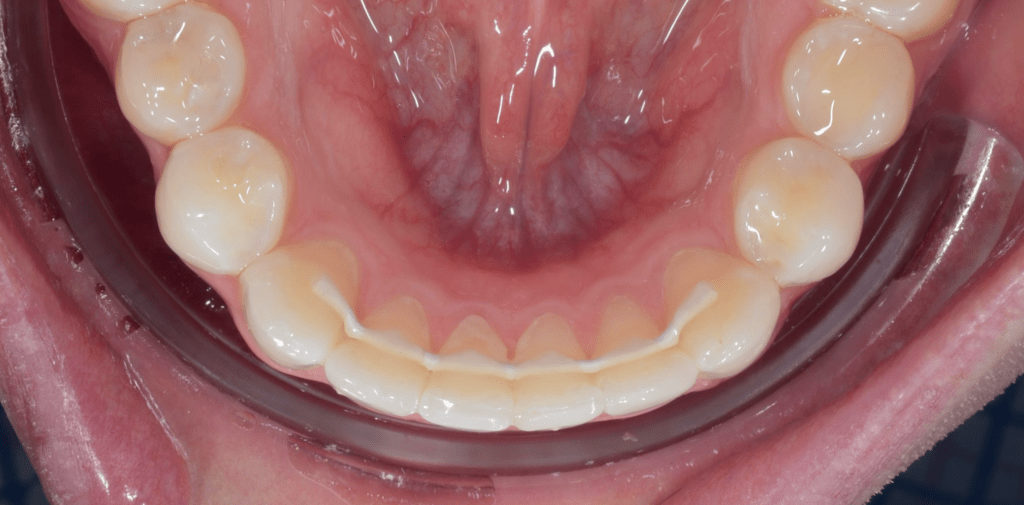
Table Of Contents
show
- The Role of an Orthodontic Retainer Wire
- Is the Orthodontic Retainer Wire Effective?
- Why Do Your Teeth Shift After Orthodontic Treatment?
- The Three Main Types of Orthodontic Retainers
- Can Teeth Shift with a Retainer Wire?
- What Do Studies Say?
- When Should the Retainer Wire Be Removed?
- Is the Retainer Wire Worn for Life?
- How Is an Orthodontic Retainer Wire Placed?
- Common Problems with Retainer Wires
- Clean your retainer wire daily
- Retainer wire prices and reimbursements
- Next-generation orthodontic retention
- FAQ – Your frequently asked questions
- The retainer wire – in conclusion
The Role of an Orthodontic Retainer Wire
A retainer wire is a thin, discreet arch, bonded behind the incisors and canines. As a fixed retainer, it acts as a permanent “retainer”: it neutralizes the tissues’ elastic memory and prevents teeth from returning to their original position on the dental arch. In practice, it blocks the micro-movements responsible for crowding or the reopening of a diastema – two common complications without retention.
Is the Orthodontic Retainer Wire Effective?
Yes, the retainer wire is effective, and this is proven both clinically and scientifically.
Worn 24/7, the retainer wire provides continuous retention: it blocks the micro-movements responsible for crowding or the reopening of a diastema — in other words, the space between two front teeth that was closed thanks to orthodontics.
As a result, metallic retainer wires, although effective, have several limitations: they can debond or break over time, require more rigorous maintenance, remain slightly visible… and must be removed before an MRI of the head or neck. It should be noted that a PEEK orthodontic retainer wire eliminates all these drawbacks: unbreakable, aesthetic, MRI-compatible, and above all, perfectly fitted to your dentition. It ensures reliable and continuous stability without discomfort or constraint.
You’ll forget it’s there, but it won’t — it will watch over your smile day and night.
Why Do Your Teeth Shift After Orthodontic Treatment?
Why Do Your Teeth Shift After Orthodontic Treatment? Even after your braces or aligners are removed, your teeth remain alive: they are connected to the bone by elastic periodontal fibers.
After being moved, these fibers naturally seek to regain their original length, creating a recoil force that causes teeth to shift back.
Three major factors explain these shifts:
- Tissue Elastic Memory
The periodontal ligaments and gums retain the memory of the initial position; without retention, they gently pull the teeth back. - Daily Muscular Forces
The tongue, lips, and even swallowing exert small, repeated pressures. On freshly aligned teeth, these forces are enough to cause slight crowding. - Growth or Bone Remodeling
In adolescents, jaws continue to grow, but even in adults, bone remodels throughout life. These changes alter the available space and promote late shifts. (Orthodontics: Current Principles and Techniques, 6th Edition, Graber, Vanarsdall & Vig, Elsevier, 2021.)
French Society of Dento-Facial Orthopedics (SFODF), Patient Guide to Orthodontics.
The result? Progressive crowding, reopening of spaces, imperceptible rotation of an incisor… Movements that are often slow, but irreversible without a stabilization device. The retainer wire acts as a permanent splint: it neutralizes these residual forces and guarantees the long-term stability of your smile.
The Three Main Types of Orthodontic Retainers
Today, three main types of orthodontic retention are available: the traditional twisted stainless steel wire, removable night-time retainers, and the PEEK retainer wire—the latest technological innovation combining comfort, discretion, and reliability.
| Criterion | Steel wire | PEEK eZtain | Removable Retainer |
| Comfort | ★★★☆☆ | ★★★★★ | ★★★★☆ |
| Aesthetics | Dark wire behind teeth | White color, discreet on teeth | Almost Invisible |
| Hygiene | Interdental brushes required | Simplified hygiene | Separate cleaning |
| Durability | 2–3% breakage/year | 0% breakage at 5 years | To be replaced every 2–3 years |
In summary, the PEEK eZtain solution therefore combines the reliability of a fixed orthodontic retainer and the comfort of a high-end material, while eliminating the main drawback of metallic wire: breakage.
The CHD Lausanne Bessières clinic favors PEEK retainers for their exceptional resistance and custom fit. Patients appreciate a more aesthetic, metal-free, and perfectly tolerated daily solution. Since the introduction of this technology, the team has observed a significant decrease in emergencies related to broken wires. This approach ensures lasting stability without the drawbacks of classic metallic retainers.
Can Teeth Shift with a Retainer Wire?
Yes, teeth can shift with a retainer wire, but this remains rare and preventable. This occurs mainly if the wire debonds, even slightly, or if it was placed under tension, which can exert an undesirable force. Poor hygiene can also promote tartar accumulation, destabilizing the wire.
When the retainer is intact and maintained, scientific literature shows over 95% stability at ten years.
What Do Studies Say?
- Long-term Stability: A study on retainer wire published in 2024 in the Journal of Orthodontics shows that, when well-maintained, a fixed retainer keeps teeth aligned in 96% of cases, even after 10 years.
- Wire Types: PEEK wires (custom-made by computer) exert very little pressure on the teeth upon placement, 4 times less than some handmade metallic wires. This limits unwanted movements and ensures nearly 100% stability at 10 years.
- Oral Hygiene: People who use interdental brushes and a fluoride mouthwash have 40% less plaque. Result: the wire debonds less often, because it is less affected by bacteria or mechanical forces.
In summary, your teeth will not shift as long as the wire remains intact and your gums are healthy. The PEEK eZtain system optimizes these two parameters: zero documented breakage and an ultra-smooth surface limiting plaque accumulation.
If you notice any anomaly, consult your orthodontist without delay; the faster the intervention, the more stability is guaranteed.
What to Do if in Doubt
- Visually check that the wire is still bonded to each tooth.
- Run your tongue over it: if the wire moves, make an appointment within 48 hours.
- A small night guard can serve as an additional “safety belt” for high-risk cases; discuss this with your orthodontist.
When Should the Retainer Wire Be Removed?
For the vast majority of patients, the correct answer remains: never — as long as the retainer wire is intact and well tolerated, it can remain in place for life.
There are, however, six well-defined clinical situations in which the orthodontist will choose to remove it (and, in most cases, replace it immediately).
| Situation | Why is it removed? | What Happens Next |
| Caries Treatment / Aesthetic | The wire obstructs access to a cavity or a composite that needs replacement. | New segment re-bonded the same day. |
| Targeted Periodontal Surgery | Gum recession or bone regeneration. | New wire (or night guard) after healing. |
| Very Insufficient Hygiene | Recurrent tartar under the wire; risk of periodontitis. | Permanent removal or replacement with a smoother, better-adapted PEEK eZtain. |
| Prosthetic Work | Implants, veneers, anterior crowns. | Wire removed for impression, re-bonded after placement. |
| Proven Nickel Allergy | Rare, concerns metallic wires. | Switch to PEEK eZtain wire (metal-free). |
| Patient’s Aesthetic Choice | Need for “freedom” after ≥ 5 years of stability. | Accepted if night guard worn for life. |
However, it is important to remember: the removal of a retainer wire is never automatic. It is only considered for medical or technical reasons, for example, in the case of an MRI. Metallic wires must then be removed. A PEEK retainer wire, however, can be kept in this scenario.
A retention solution (new wire or aligner) is systematically planned to prevent any relapse. Discuss this with your orthodontist: you will jointly decide on the best strategy to maintain a perfectly aligned smile.
Want to know more about the lifespan of a retainer wire? Our complete article on how long to keep your retainer is here for you.
Is the Retainer Wire Worn for Life?
Yes. Today, orthodontists recommend keeping the retainer wire for life. Indeed, teeth can still shift over time, even after a successfully completed treatment. The wire acts as a safeguard: it prevents incisors from naturally crowding as one ages.
How Is an Orthodontic Retainer Wire Placed?
The placement of a retainer wire is a quick, painless procedure perfectly mastered by practitioners. It takes place in a few precise steps, directly at the clinic, and generally takes no more than 15 minutes. Here’s how it works.
*Total time: ~15 minutes *
- Cleaning and Drying
The practitioner carefully cleans the inner surface of your teeth, then places small cotton rolls (or a dental dam) to keep the area dry. - Wire Trial
The custom-made wire is dry-fitted to ensure it adapts to the arch without exerting pressure. - Enamel Preparation
A gel is applied for 20 seconds to create micro-retention, then the surface is rinsed and dried. - Adhesive Application
A drop of flowable composite is placed on each tooth that will receive the wire. - Positioning and “Flash”
The wire is pressed against the teeth; a blue light cures it in a few seconds. - Covering
With macro-filled composite, the wire is covered on each tooth to keep it in place long-term. - Finishing and Control
The edges are polished, and your bite is checked to ensure it doesn’t touch the adhesive, making sure everything is smooth and stable.
For a more detailed explanation of the process, visit our article dedicated to retainer wire placement and discover everything you need to know.
Post-Placement Sensations: What to Expect?
- Days 1 to 2: A slight feeling of thickness under the tongue may appear, sometimes accompanied by a slight tingling sensation. Nothing abnormal; the body is simply getting used to the presence of the wire.
- First week: Adaptation occurs naturally. The majority of patients completely forget about the wire after a few days.
- In case of pain? No need for painkillers in the vast majority of cases. If unusual discomfort persists beyond 48 to 72 hours, contact your clinic for a quick check-up.
Immediate Retainer Maintenance: Best Practices
From the evening of placement, it is crucial to properly clean your retainer wire to prevent irritation and plaque accumulation.
Start by gently brushing the area with an extra-soft toothbrush, without applying pressure. This gentle cleaning helps eliminate initial bacteria while respecting the composite resin that secures the wire.
During the first 7 days, an alcohol-free chlorhexidine mouthwash (0.12%) is highly recommended. It helps to disinfect the area, limits bacterial proliferation, and promotes healing of the gums and tongue. This makes the wire easier to tolerate daily.
🦷 Tip: clean the area every evening with special care around the wire. This reduces the risk of inflammation and extends the lifespan of your retainer.
Rigorous cleaning from the first few days prevents future discomfort (annoyance, debonding, irritation) and forms the basis of lasting oral hygiene.
Common Problems with Retainer Wires
Disclaimer
The advice below does not replace a consultation. If in doubt, contact your orthodontist.
| Problem | Warning Signs | What to Do Immediately? | Consultation Deadline |
| Broken Retainer Wire (rare: 0% PEEK) | Sharp point, “click” under the tongue | Cover the area with orthodontic wax; avoid hard foods. | < 48 h |
| Debonded wire from a tooth | Wire is loose, small visible gap | Do not pull on it! Limit front chewing. | < 72 h |
| Pain / irritation | Lingual ulcer, speech discomfort | Wax + soothing mouthwash; paracetamol if needed. | < 5 days if it persists |
| Heavy calculus / bleeding gums | Yellow deposits, bleeding when brushing | Daily interdental brushes + scaling appointment. | < 2 weeks |
| Rare hypersensitivity (metal) | Redness, metallic taste | Hypoallergenic PEEK eZtain solution. | Depending on urgency |
Instructions in case of an incident
- Inspect your wire in the mirror: each adhesive pad must cover the wire without any gap.
- Apply a ball of wax or a piece of sugar-free chewing gum to the sharp area.
- Note the date of the problem: the sooner you consult, the less time your teeth have to shift.
- Wear your night guard (if you have one) until your appointment: it stabilizes the arch while awaiting repair.
With PEEK eZtain, the mechanical risk is almost zero; however, a direct impact (sports, olive pit, chewed pen) can still debond an adhesive point. The rule: act quickly – a repair takes 10 minutes and prevents any recurrence.
Clean your retainer wire daily
A fixed retainer wire is the keystone of your orthodontic stability; meticulous hygiene is therefore essential for it to last without causing cavities or inflammation. Follow this detailed protocol; it easily fits into your routine and takes no more than two minutes after each meal.
1. Choose the right toothbrush
| Type | Advantages | Considerations |
| Soft manual (“soft” blister pack) | Precise manual control; fine bristles that pass under the wire | Change every 2 months (splaying bristles). |
| Oscillating/rotating electric | Circular motion that “lifts” plaque from the adhesive; 2-minute timer | Brush tooth by tooth; do not force the handle, as you risk damaging your enamel. |
| Sonic | Vibrations >30,000 Hz: flushing effect under the wire; very gentle on gums | Maintain the head at 45° on the lingual surface. |
eZtain Tip
PEEK offers a smooth surface; a sonic brush removes plaque without scratching the resin, limiting biofilm formation.
2. Interdental brushes: the second line of defense
- Choose the right interdental brush size
Each color corresponds to a diameter. To start, opt for 0.6 mm, it’s often ideal. Then adjust according to the space between your teeth. - Use it where it truly matters
Gently slide the brush under the wire, towards the space between the teeth.
Make two small back-and-forth motions, no more: there’s no need to force it. - Do not neglect the highest-risk area
Prioritize the space between your two lower incisors (31–41): this is where calculus accumulates first.
3. Special dental floss (super-floss)
- Pass the rigid end under the retainer wire.
- Rub the spongy part on the tooth and then on the adjacent enamel.
- Wrap, pull, and change segments at each space.
Contrary to myth, a retainer wire does not prevent the use of super-floss. On the contrary, the use of dental floss is recommended to maintain proper hygiene of your retainer wire, especially if it is not perfectly flush against your teeth.
4. Rinsing and fluoride agents
After brushing and using the interdental brush, rinsing plays a key role in the daily maintenance of your retainer wire. When chosen correctly, a mouthwash can not only strengthen enamel but also reduce bacteria responsible for inflammation and calculus.
| Timing | Product | Role |
| Day 0 → Day 7 | 0.12% Chlorhexidine mouthwash | Reduces post-placement bacterial load, accelerates gingival / lingual healing in case of irritation |
| Long term | 0.05% Fluoride rinse (225 ppm) 2 ×/week | Strengthens enamel, reduces sensitivity. |
| In case of dry mouth | Xylitol gel or spray | Maintains salivary flow, buffers acidity. |
5. What to eat after retainer wire placement?
Once you leave the bonding appointment, the adhesive is already hard. No particular diet is required.
However, even in the long term, certain habits can weaken your retainer.
- To limit in the long term: sodas, acidic juices, caramels, nougats, and other sticky candies. Their high sugar content and adhesive texture can weaken the retainer wire’s resin and promote calculus accumulation.
- Recommended: cheeses (calcium intake), crunchy fruits cut into pieces (gentle gum stimulation), and nuts like almonds or walnuts, rich in phosphorus and beneficial for dental enamel.
6. Necessary professional follow-up post-retention
A well-placed retainer wire can last for years… provided it is properly maintained. Follow-up with your orthodontist is not just to “take a look”: it allows for the detection of initial debonding, calculus buildup, or micro-movement even before you feel it.
Here is the ideal rhythm to adopt to keep your retainer 100% effective, without unpleasant surprises:
| Frequency | Procedure performed | Why it’s important |
| Every 6-9 months | Scaling + adhesive check | Removes calculus behind the bar, polishes the resin, and checks that the wire is still securely attached. |
| Every 12 months | Photos + optical impression | Allows comparison of year-to-year evolution and to detect less than 0.1 mm of displacement. |
| Every 3 to 5 years | Composite polishing | Revitalizes the adhesive surface and seals micro-porosities where plaque can accumulate. |
In figures:
Patients following this routine show 40% less plaque and a 70% lower caries risk compared to a group without interdental brushes (Univ. Lyon 1 Study, 2024).
Retainer wire prices and reimbursements
To assess the price of a retainer wire, one must distinguish: the material (steel or PEEK), clinical time (placement, checks), and your insurance policy. The figures below reflect the average observed in French practices in 2025; they may vary by ± 15% depending on the region and the practitioner’s experience.
| Procedure / Device | Average price incl. tax* | Social Security reimbursement** | Insurance coverage*** |
| Fixed steel wire (1 arch) | €300 | €0 (>16 years old) / €161.25 (<16 years old, 1st year of retention code TO75) | Orthodontic package €50–150 |
| Fixed PEEK eZtain wire (1 arch) | €350 – 450 | €0 (>16 years old) / €161.25 (<16 years old, 1st year of retention code TO75) | Premium insurance: €100–200 |
| Essix retainer (1 arch) | €200 | €0 (>16 years old) | €50–100 (depending on contract) |
| Wire repair / re-bonding | €70 – 90 | Not listed | Variable (rarely covered) |
* Survey by the Order of Dental Surgeons & French Union of Orthodontists, March 2025.
** Ameli scale “Post-treatment retention”; prior agreement before 16 years old.
*** Consult your guarantee table: “adult orthodontics” contracts reimburse on an annual basis.
Budget tip for your retention treatment
- Some practitioners integrate PEEK retention into the overall treatment package to smooth out the expense, speak to yours!
- Opt for a PEEK treatment guaranteed against breakage to avoid having to cover the repair of a classic retainer wire.
Next-generation orthodontic retention
Orthodontics continues to evolve — and retention with it.
Materials are becoming lighter, more resistant, and better tolerated. Design techniques, meanwhile, are becoming increasingly personalized, thanks to 3D modeling and computer-aided manufacturing.
What remains unchanged is the need for reliable, durable, and comfortable retention.
But what is profoundly changing is how to achieve it.
PEEK retainer wires represent the next step
For over 10 years, the importance of maintaining a retainer wire for life has been proven. To meet this requirement, technology is advancing: today, wires are more reliable, more comfortable, and much better tolerated.
In the 90s, retainer bars were bulky, rough, and often prone to breakage. Since then, they have evolved into thinner, lighter, and almost imperceptible formats in the mouth.
The latest innovation is PEEK retainer wires. By replacing manual bending still practiced in many clinics, PEEK allows for custom manufacturing that is more precise, more comfortable, and above all… unbreakable.
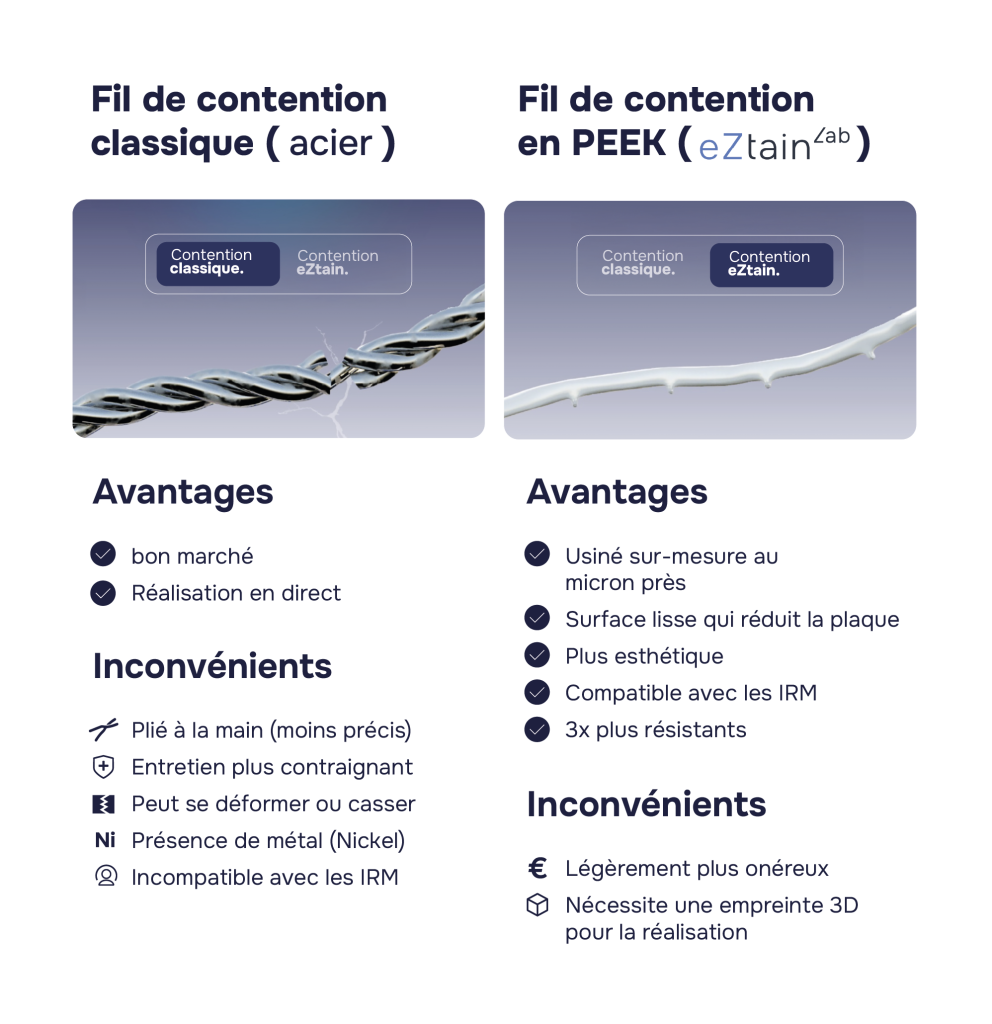
Our partner orthodontists all confirm the same thing: among all solutions tested in practice, the PEEK wire remains the only one capable of combining aesthetics, long-term comfort, and mechanical reliability.
According to them, it is the most credible alternative to guarantee lifelong stabilization, without constraints for the patient.
FAQ – Your frequently asked questions
Can I eat normally with a retainer wire?
Yes, but adopt a few habits: cut very hard foods (apple, baguette); avoid caramel or nougat which can pull on the adhesive. PEEK eZtain is highly resistant to chewing; however, caution extends the lifespan of the retainer.
Does the retainer wire cause cavities?
No, the wire itself is not cariogenic. Cavities occur if plaque accumulates around the adhesive. Rigorous brushing and interdental brushes after each meal eliminate this risk.
What to do if I feel a metallic taste in my mouth?
A metallic taste often indicates micro-debonding of an old steel wire. PEEK eZtain does not have this drawback. If you perceive this taste, schedule an appointment for a check-up and consider replacing it with a PEEK wire.
Does the retainer wire change my pronunciation?
In the first few days, your tongue may brush against the bar; a slight “lisping” phonation may appear. After one week, 99% of patients no longer perceive any difference in speech.
Can teeth be whitened with a fixed retainer wire?
Yes. Whitening gels do not damage PEEK or the adhesive. Simply ask your dentist to protect the gums during the session.
How to travel by plane with a retainer wire? and a PEEK wire?
Yes, no problem. Retainer wires, whether metallic or PEEK, do not trigger security gates and do not interfere with body scanners. PEEK, in particular, is radiolucent and non-magnetic.
Can the retainer wire stain with coffee?
With a classic retainer wire, it’s not the metal wire that stains, but the composite resin that fixes it to the teeth. This resin can stain with coffee, tea, or red wine. A quick in-office polish can correct this.
With eZtain, the PEEK wire remains naturally stable : it does not yellow, does not stain, and maintains its discreet appearance longer.
What is the maximum age for retainer wire placement?
There is no strict limit. As long as the gums and bone are healthy, a wire can be placed – even after 60 years of age – to stabilize a late realignment or protect an implant-supported prosthesis.
The retainer wire – in conclusion
A well-maintained retainer wire remains, even today, the best guarantee of a lifelong aligned smile. Invisible, silent, yet remarkably effective, it protects months — sometimes years — of orthodontic efforts.
Ultimately, among the available options, the PEEK eZtain wire stands out: zero measured breakage, immediate comfort, unparalleled aesthetics, and easy maintenance. That is why it embodies today what modern orthodontics offers that is most reliable and discreet.
I created eZtain to address a concrete clinical need: to finally offer a fixed retainer that lives up to its promises.
In partnership with INSA, we developed a custom PEEK solution: more comfortable, more precise, and above all, durable.
Today, eZtain is no longer a gamble. It is a technology adopted in dozens of practices in France, recommended by my colleagues, and proven daily in real-world situations.
If you are looking for a reliable retainer, designed to last, you are in the right place.
Want to learn more?
Talk to your orthodontist about it.
Because a beautiful smile is good — but an aligned smile is even better.
About the Author
Dr. Nicolas Philippides is an orthodontist graduated from the University of Strasbourg, holding a CES in dentofacial orthopedics. With several years of practice in a clinic, he has supported hundreds of patients in their orthodontic treatment, with a constant commitment to long-term stability and comfort.
Faced with the limitations of conventional retainers, he decided in 2022 to found eZtain Lab: a project born from a simple but recurring clinical observation — too many relapses due to poorly adapted or overly fragile wires. In collaboration with INSA, he developed a new generation of PEEK retainer wires, custom-made, comfortable, and durable.
Today, his research and experience fuel a single ambition: to offer reliable devices, designed to last, and adapted to the requirements of modern orthodontics.