
Hello ! Click on one of our team members below to chat on WhatsApp.
Orthodontic Retainer: Definition, Duration, Limitations, and Reliable Alternative
The orthodontic clear retainer, a transparent shell worn at night, is appealing due to its aesthetics but presents challenges: daily discipline, frequent loss, rapid wear (18–36 months), high recurring cost (€600–€1,200 over 10 years), and a significant risk of relapse (70% if forgotten). It should not be confused with invisible aligners: unlike them, its purpose is not to move teeth, but to preserve the results achieved after treatment. While not reimbursed, it offers several advantages but can promote plaque and cavities if oral hygiene is imperfect.
Conversely, the fixed retainer made of PEEK eZtain is placed only once, is invisible because it’s bonded behind the teeth, is biocompatible, requires no patient effort, is virtually unbreakable (≥ 5 years), and provides 24/7 protection with no risk of being forgotten. For long-term stability, it is currently the most reliable option.
Introduction
At the end of orthodontic treatment, the stabilization phase occurs. After orthodontic treatment has allowed for
A first stabilization phase of two and a half years is carried out by placing a mandatory retention wire. After this, wearing an orthodontic clear retainer becomes possible, which many patients then imagine as a solution to improve their quality of life. However, as we will see in this report, this is not always true.
This article thus explains in detail the actual functioning of the clear retainer, its cumulative cost, its limitations, and its potential alternatives.
This content does not replace a personalized consultation; only an examination by your orthodontist can determine the appropriate solution.
Table of Contents
Show
- Introduction
- What is an orthodontic clear retainer?
- What is the cost of an orthodontic clear retainer?
- Are clear retainers reimbursed by Social Security?
- Can a clear retainer damage teeth?
- What is the lifespan of a dental clear retainer?
- What are the disadvantages of a dental clear retainer?
- Clear Retainer or Fixed Retention Wire? The Decisive Showdown
- Which type of retention for which profile?
- My advice before choosing your orthodontic retainer
- My verdict on the clear retainer as a practitioner
What is an orthodontic clear retainer?
An orthodontic clear retainer is a very thin, transparent shell worn at night to maintain the alignment achieved after braces; it only serves to prevent teeth from shifting back.
The Retention Clear Retainer: Success, Limitations, and Evolution
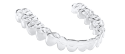
Originally, the modern retention clear retainer was developed in the 1970s: a simple thermoformed plastic film, quickly adopted by orthodontists to offer an aesthetic alternative to rigid resin plates. Since then, the technique has become widespread thanks to 3D scanning; the laboratory heats a thin sheet of biocompatible plastic that precisely conforms to the surface of each tooth, without wires or metal attachments.
The solution truly took off in the 1990s, when thermoplastic sheets became thinner and the first intraoral scanners made impression-taking more reliable: the clear retainer then became a discreet, inexpensive, and quick-to-manufacture method to “lock in” a completed treatment. In the 2000s, driven by the rise of clear aligners (Invisalign © and similar products), it even rose to the status of a standard, particularly in the United States and major European university centers.
However, since 2015, the initial enthusiasm surrounding clear retention retainers has significantly tempered. Numerous studies have highlighted a major long-term compliance issue: fewer than one in three patients continue to wear them correctly after three years. As a result, the risk of orthodontic relapse increases sharply, while successive replacements — often due to loss, breakage, or deformation — significantly increase the cost.
The profession has therefore refocused retention on fixed wires — now made of biocompatible PEEK — reserving the clear retainer for a supplementary role rather than the primary safeguard.
How is an orthodontic clear retainer fitted?
A retention clear retainer is prepared in two stages: first, an impression (or 3D scan) is taken, then custom fabrication in the laboratory from thermoformed plastic.
Initially, the orthodontist performs a 3D scan (a digital impression via a suitable scanner) of your teeth; this digital “mold” then goes to the laboratory.
Next comes the second part, where a thin sheet of biocompatible plastic is heated to conform to your teeth model: this is the transparent shell you will wear.
At the next appointment, the appliance is tried on; the clear retainer must snap into place without force and respect functional occlusion, meaning it must allow the jaws to close normally without hindering chewing or speech.
After a few possible edge adjustments, the practitioner finally hands you the clear retainer, specifies the wearing duration (often day and night for the first two weeks, then only at night), and demonstrates how to clean it to prevent bacterial plaque. A check-up is scheduled a few weeks later to ensure your dental alignment remains stable.
In practice: the 4 key steps
- Scan or impression – the final position of your teeth is captured.
- Custom thermoforming – the plastic sheet is molded and then polished.
- Trial and adjustments – fit and absence of discomfort when closing the mouth are checked.
- Regular follow-up – clinical check to prevent any orthodontic relapse.
What is the cost of an orthodontic clear retainer?
Depending on the practice, a clear retainer costs between €150 and €400 per arch, to be replaced every 1 to 3 years on average due to wear, loss, or deformation.
However, when inevitable replacements due to loss, deformation, or simple wear are added, the cost quickly escalates: over ten years, an adult can spend from €800 to over €1,200 to maintain suitable clear retainers.
In addition to these costs, there are extra visits, sometimes billed, to retake impressions and check dental alignment. The cost of a retention wire is therefore systematically lower than the cost of a clear retention retainer in the long term.
Compared to the PEEK retention wire — placed only once, checked during standard annual reviews, and virtually undetectable in the mouth —, the clear retainer budget proves, in the long term, far less advantageous than it initially appears.
The cumulative cost of clear retainers over the years
| Year | Retainer Replacements | Cumulative Spent (€) |
| 1 | 1 | €200 |
| 3 | 2 | €600 |
| 5 | 3 | €900 |
| 10 | 5 | €1,500 |
| PEEK Wire (Reference) | 1 placement | €250 – €350 |
Are clear retainers reimbursed by Social Security?
No, retention clear retainers are no longer reimbursed by Social Security after age 16, and most mutual insurance companies only cover a small portion.
In practice, health insurance considers retention as an out-of-nomenclature procedure for adults; only a few high-end supplementary insurances can reimburse €50 to €100 per year upon presentation of a quote.
This regular out-of-pocket expense, combined with frequent replacements, quickly raises the question of long-term cost-effectiveness — especially when a fixed retainer, often included in the final treatment phase, incurs little to no additional costs.
Can a clear retainer damage teeth?
An orthodontic clear retainer is unlikely to damage teeth if hygiene is impeccable; however, it can promote the development of cavities or inflammation if plaque accumulates between the enamel and the shell.
However, when worn every night for several hours, the clear retainer creates a closed, warm, and humid environment that promotes bacterial proliferation if the teeth or the retainer are not properly cleaned.
Plaque thus remains trapped between the enamel and the plastic, which can lead to the appearance of white spots, cavities near the gums, and can even cause gum irritation (gingivitis).
These effects are even more common among adolescents, who are often less rigorous in their hygiene routine.
In parallel, the fixed retention wire significantly limits dental plaque accumulation — and when it is made of PEEK, this risk becomes almost non-existent, as the material offers no adhesion for deposits.
What is the lifespan of a dental clear retainer?
The average lifespan of a dental retention clear retainer is 18 months to 3 years, depending on wearing compliance, daily cleaning, and exposure to heat or impacts.
Over time, thermoformed plastic slowly loses its rigidity. It micro-cracks due to occasional chewing, water heat, or overly vigorous brushing. After two years, the retention clear retainer no longer provides the necessary long-term retention for teeth to stay in place. It must then be replaced to prevent any orthodontic relapse.
Many then believe they can stop without consequences. This is false. Once chosen, a clear retainer commits you long-term. It protects your results as long as it is in good condition — but as soon as it is no longer, the risk of relapse becomes real, sometimes rapid, always costly.
What are the disadvantages of a dental clear retainer?
Wearing a dental clear retainer involves real constraints, such as possible irritations and slight pain upon waking, but above all, a real risk of needing to restart treatment if it is forgotten too frequently.
In real life, statistics speak for themselves: 90% of patients stop wearing their clear retainer three years after the end of their dental treatment; 70% then see their dental alignment degrade.
And for good reason, the clear retainer is easily lost; at a restaurant or while traveling, it is all too often quickly forgotten. It can also break under the force of dentition or deform in water that is too hot. Each incident equates to a period without retention and an emergency visit to the orthodontist.
Clear Retainer or Fixed Retention Wire? The Decisive Showdown
| Criterion | Orthodontic Clear Retainer | PEEK eZtain wire |
| Wear | Nightly (or even continuous) depending on the period; patient-dependent | Permanent; no patient action required |
| Aesthetics | Invisible on teeth but visible out of mouth | Invisible and bonded to the lingual surface |
| Durability | 18–36 months, recurring replacement | ≥ for life, almost zero breakage rate |
| Hygiene | Daily cleaning of the shell | Interdental brushes around the wire |
| Cost over 10 years | €600–€1,200 or more | Single procedure ≤ cost of a single clear retainer cycle |
| Relapse if forgotten | High (70% without wear) | None (wire intact 24/7) |
And for parents: why the fixed retention wire is reassuring for minors.
For adolescents, the retention clear retainer often poses long-term problems. Forgetting to wear it is frequent — between homework, training, outings, and nights away from home, the expected diligence exceeds what can reasonably be demanded at that age. Result: irregular wear, lost or deformed clear retainers, and sometimes even a silent relapse that is only discovered several months later.
Conversely, the PEEK retention wire provides significant peace of mind. It is easily forgotten in daily life, does not hinder speech or meals, and remains invisible to others.
This is why, for minors, the PEEK retention wire remains today the most favored solution by both practitioners and families.
What type of retention for which profile?
Each retention solution has its advantages… but also its limitations depending on the patient’s profile. Motivation, age, habits, allergies, or budget: these are all criteria that should guide the choice between a clear retainer, metal wire, or PEEK eZtain wire.
This table helps clarify.
| Profile | Clear Retainer | PEEK eZtain wire | Metal Wire |
| Motivated / Diligent Adult | Yes | Yes | Yes |
| Adolescent | No | Yes | Yes |
| Patient allergic to metal | Yes | Yes | No |
| Tight long-term budget | High cost (> €600) | Yes (one-time) | Yes |
My advice before choosing your orthodontic retainer
As an orthodontist for over ten years, I have guided many patients in choosing their retention after treatment. Before deciding on a solution – whether it’s a clear retainer or a retention wire – I strongly recommend following a few essential steps to avoid any unpleasant surprises, whether medical or financial.
- Schedule a periodontal examination: a retainer should never be placed in the presence of gingival inflammation (inflammation of the gums), periodontal pockets, or active carious lesions.
- Honestly assess your motivation: if you feel that daily nightly wear might be difficult to maintain long-term, a fixed wire – especially PEEK – will often be more suitable, comfortable, and secure.
- Request a clear and written follow-up protocol: it should specify the frequency of check-ups, hygiene advice to follow, and the procedures planned in case of device displacement.
What is the true value of an orthodontic clear retainer?
The removable retainer was developed to meet two specific expectations: aesthetics (it is invisible once worn) and freedom (it can be removed for eating or brushing teeth). For many patients, these two advantages are enough to convince them. However, they come with constraints that should not be underestimated:
| Benefits of the Removable Retainer | Actual Limitations |
| ✔ Nearly invisible ✔ No metal, therefore no allergies or MRI artifacts ✔ No speech discomfort once accustomed | Nightly wear for life if total stability is desired Easy to lose, break, or deform; replacement every 18–36 months Cumulative cost (6 to 8 retainers over 10 years) Risk of cavities and gingivitis if hygiene or motivation declines |
In practice, compliance (regularity of wear) is the Achilles’ heel: forgetting to wear the retainer for a few nights in a row is sometimes enough to restart tooth movement, and after three years, fewer than one in three patients still wear it correctly…
Why Fixed Retainers Are Making a Comeback… and Getting Modernized
For a long time, the “default” solution was the bonded metal retainer. Strong, effective, but:
- it could break or debond,
- it retained plaque,
- and some patients found it uncomfortable to feel the metal against their tongue.
These minor inconveniences led many practitioners and patients towards the removable retainer. But today, the retention wire is evolving: it is now available in PEEK (polyether-ether-ketone), a smooth, white, metal-free medical polymer.
Result:
- Invisible and imperceptible to the tongue
- No allergies or MRI artifacts
- Very smooth surface: significantly less plaque than a steel wire
- Single placement: annual check-up, no recurring replacement
- 24/7 retention without depending on patient motivation
My verdict on the clear retainer as a practitioner
The orthodontic aligner remains relevant if you are disciplined, appreciate being able to remove the appliance, and accept the replacement budget. The PEEK fixed retainer, however, combines the best of both worlds: continuous reliability, comfort, aesthetics, and simplified maintenance. This is why more and more practitioners — and parents for their teenagers — are now choosing it as a first-line solution.
About the Author
Le Dr Nicolas Philippides est orthodontiste diplômé de l’Université de Strasbourg, titulaire d’un CES en orthopédie dento-faciale. Fort de plusieurs années de pratique en cabinet, il a accompagné des centaines de patients dans leur traitement orthodontique, avec un engagement constant pour la stabilité et le confort à long terme.
Face aux limites des contentions classiques, il décide en 2022 de fonder eZtain Lab : un projet né d’un constat clinique simple mais récurrent — trop de récidives dues à des fils mal adaptés ou trop fragiles. En collaboration avec l’INSA, il développe une nouvelle génération de fils de contention en PEEK, sur mesure, confortables et durables.
Aujourd’hui, ses recherches et son expérience nourrissent une seule ambition : proposer des dispositifs fiables, conçus pour durer, et adaptés aux exigences de l’orthodontie moderne.