
Hello ! Click on one of our team members below to chat on WhatsApp.
How long should a dental retainer wire be worn?
You may have just completed your orthodontic treatment, and the idea of wearing a fixed appliance ‘for life’ may seem daunting. Rest assured: the retainer wire is primarily a stabilization phase that secures your new dental alignment against any orthodontic relapse. Invisible and painless, no matter the duration, you won’t notice your new retainer wire.
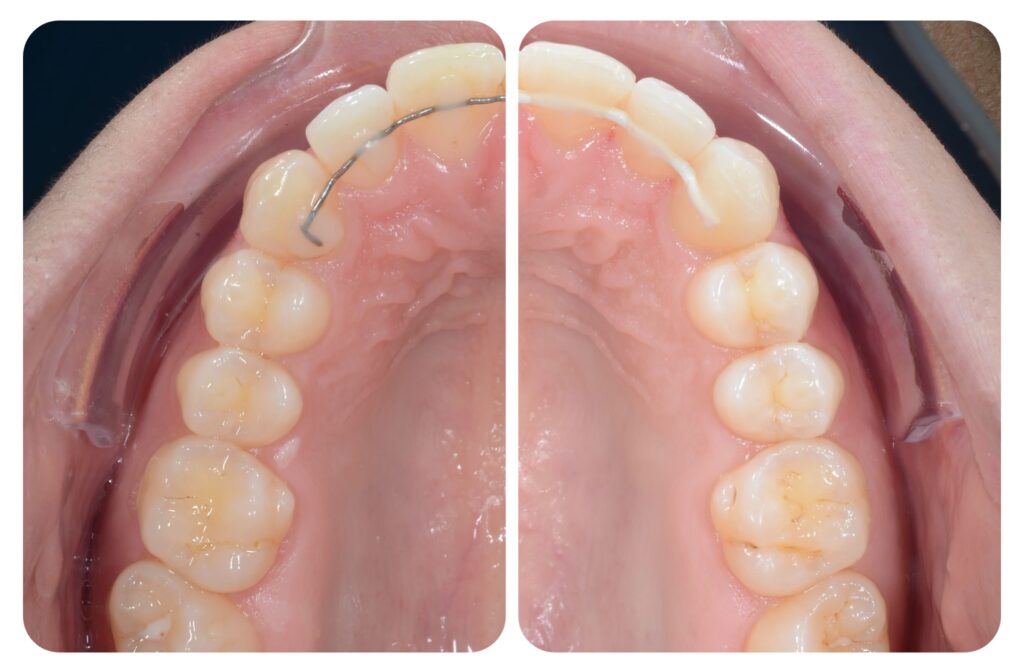
Discover how a retainer wire is placed and the precautions to take within the first 24 hours.
Why the duration of retention is not the same for everyone.
Without a retainer wire, up to 90% of orthodontic treatments would fail in the long term. Even after several years, the risk of tooth movement remains real (40% at ten years).
The retainer wire therefore plays a crucial role in the stabilization of your dental alignment.
After the removal of your appliance, your teeth are still vulnerable. The periodontal fibers, responsible for anchoring them in the bone, take several years to completely reform. During this period, masticatory forces and tongue pressure can lead to orthodontic relapse (relapse).
The duration of wire wear is therefore directly linked to your body’s ability to consolidate the new dental alignment and the daily forces exerted: mastication, tongue pressure, or even bruxism.
Once the critical year has passed, the bone and gums continue their maturation. The wire remains essential, but annual check-ups are usually sufficient.
Recommended duration for a retainer wire
Orthodontists consider three main time phases; each addressing a specific biological need:
Critical Phase: 0 to 12 months
The first few months are the most critical. The wire acts as an essential lock: it blocks the natural forces of the periodontal fibers — these ‘elastic bands’ that connect the teeth to the bone — while the alveolar bone, the thin bone structure that supports the teeth, rebuilds around their new position. Removing the retainer too early would carry a high risk of rapid tooth movement.
A quarterly check-up is then performed by your orthodontist to ensure the long-term stability of your retainer.
Consolidation: 1 to 5 years
Once the critical year has passed, the bone and gums continue their maturation. The wire remains essential, but biannual or annual check-ups are usually sufficient. The practitioner checks for wire passivity, absence of plaque, and adjusts hygiene if necessary. This phase ensures the long-term stability of the result.
Factors influencing the duration of a retainer wire
Just a decade ago, we believed that many factors influenced the duration of retainer wire wear.
The factors then influencing the duration of retainer wire wear were the following:
- Age: In adults, higher bone density often requires longer retention to compensate for stronger masticatory forces.
- Type of initial displacement: Large rotations or significant space closures present a higher risk of relapse.
- Oral hygiene: influences the type of retention
- Certain habits such as teeth grinding (bruxism), nail biting (onychophagia), or pushing the tongue against the teeth can lead to so-called ‘atypical’ swallowing, which generally requires lifelong monitoring.
- Material and wire integrity: A rigid or partially debonded wire loses effectiveness, which may necessitate replacement and prolong the retention period.
Lifelong Retainer Wire: Why Is It Becoming the Norm?
For a long time, permanent retention was reserved for so-called ‘at-risk’ cases — such as severe teeth grinding (bruxism), significant incisor rotations, or late facial growth. However, the most recent clinical studies show that a risk of orthodontic relapse persists throughout life:
- the alveolar bone, the supporting structure for the roots, continuously remodels;
- the periodontal fibers retain an elastic memory and can exert micro-recoil forces;
- tongue pressure, bruxism, or simple chewing habits create millimeter-scale movements over the years that eventually become visible.
Given these permanent biological constraints, leaving the wire in place indefinitely is now recognized as the most reliable strategy for long-term dental alignment security. However, thanks to advances in materials, fixed retention has evolved considerably: the old bulky metal bars have given way to ultra-thin, flexible, and completely imperceptible wires in daily life.
As highlighted by the British Orthodontic Society in its report Retention is for Life (2021), “teeth continue to move throughout life, and long-term or lifelong retention is the only way to ensure stable alignment. Modern retainer wires are discreet, thin, and very well tolerated by patients“.
With simple regular follow-up and good oral hygiene, this permanent retention thus becomes a passive, comfortable, and safe solution to durably preserve your smile.
Broken or Debonded Wire: Why Must It Be Replaced Quickly?
A deteriorated wire no longer ensures the stability of your dental alignment. In less than two weeks, small tooth migrations can appear; they reopen the door to new appliance treatment.
From a hygienic and sanitary perspective, the debonded part retains more plaque and rapidly increases the risk of cavities and gingivitis.
To avoid this all-too-common scenario, eZtain has developed a new type of retainer wire made of PEEK, an ultra-high-performance medical polymer. Since its launch five years ago, the eZtain fixed retainer has shown 0% reported breakage. Its industrial micron-level machining and the polymer prevent the micro-fissures responsible for breakages in metal wires, which are still hand-bent today, and improve patient comfort in the long term.
How to tell if your retainer wire is broken?
A broken retainer wire is detected if you feel a mobile end, if the wire pokes your tongue or gum, or if your teeth start to move slightly. If in doubt, consult your orthodontist to check the wire’s condition and perform a re-bonding or replacement if necessary.
Practically, when should you remove your retainer wire?
At least 10 years after placement, but to ensure the quality of your dental alignment and its aesthetics, the majority of orthodontists recommend keeping it for life.
What are the risks of premature removal of the retainer wire?
If the retainer wire is removed too early, your teeth risk moving again. They can overlap, reopen a space between them, or wear out faster if your bite changes. In some cases, orthodontic treatment will need to be restarted to put everything back in place.
What if a removable retainer is chosen?
Some patients consider a removable retainer tray, worn at night rather than a bonded wire. On paper, the idea may seem practical; in reality,
From an oral hygiene perspective, plastic retains moisture; if not cleaned after each use, it becomes a breeding ground for bacteria and bad odors. Finally, replacing a lost or cracked tray represents a recurrent cost, whereas a modern fixed wire remains in place, discreet and passive, for many years without special intervention.
On average, after 2 years, two-thirds of patients no longer wear their trays, according to a Cochrane study.
Clearly, the removable solution demands daily rigor and exposes patients to risks of movement that the retainer wire, on the other hand, continuously neutralizes.
A Safer Fixed Alternative: The eZtain PEEK Retainer
For those seeking a ‘zero breakage’ solution less prone to plaque accumulation, there is now the eZtain retainer, machined from a medical-grade polymer called PEEK (polyetheretherketone).
- Ultra-smooth, PEEK exhibits significantly lower roughness than traditional metal alloys, limiting bacterial adhesion and thus plaque formation.
- Machined to the micron, the bar maintains controlled elasticity without micro-fissures, unlike metal retainer wires, hand-bent by the practitioner. In five years of commercialization, no breakage cases have been reported.
- Comfort and discretion: Its very thin cross-section and neutral tint make it almost imperceptible to the tongue and eye, while remaining bonded 24/7 to block micro-tooth movements.
eZtain combines the peace of mind of a fixed wire (no nightly discipline as with trays) with a reduced risk of plaque and breakage, offering safer and more comfortable long-term retention for the patient.
FAQ –
1. How long should a retainer wire be worn?
Today, new scientific recommendations advise lifelong wear. The first 12 months are the most critical. However, teeth can still move up to 20 years after the removal of the orthodontic appliance.
.2. When can a dental retainer wire be removed?
The removal of a retainer wire is only considered after a clinical examination confirming complete tooth stabilization. Most of the time, it remains in place for several years, or even permanently, to prevent any spontaneous movement related to masticatory forces or tongue pressure.
3. What should I do if my retainer wire breaks or debonds?
If you feel a mobile end, discomfort on your tongue, or observe slight tooth movement, consult your orthodontist promptly. A broken wire must be re-bonded or replaced within seven days to avoid any risk of movement. With eZtain®, breakage is now almost non-existent.
4. What is the lifespan of a fixed retainer wire?
A well-maintained fixed retainer wire can last between 8 and 10 years on average. Its longevity depends on oral hygiene, the material used, and regular follow-up with your practitioner. Innovative materials, such as PEEK, now allow for considering permanent retention without significant wear.
Think Long-Term for an Aligned Smile
Every patient reaching the end of their treatment will ask the fateful question: how long should they keep their retainer wire? But there is never a simple answer.
The duration of retainer wire wear is not a single figure; it is decided on a case-by-case basis, depending on your risk factors and hygiene. Regardless of the situation and context, expect twelve months of strict locking, several years of consolidation, and probable lifelong retention. Regular follow-up with the orthodontist, combined with impeccable hygiene, remains the best guarantee for durably preserving your dental alignment and aesthetics.
Would you like to know more about the role, placement, and duration of a retainer wire?
Consult our complete guide to dental retainer wires to understand everything in one place.